
题目:Negative thermal expansion in metals and bond repopulation mechanism of Invar anomaly
报告人:Sergii Khmelevskyi Austrian Scientific Computing Research Center, Vienna University of Technology
时间:2026年11月2日 (星期一) 9:30-12:00
地点:师昌绪楼406会议室
报告摘要:
The Invar anomaly, a phenomenon observed in the canonical INVAR alloys Fe-Ni, has been investigated on a first-principles basis, with the inclusion of longitudinal spin fluctuations (LSRF) in the paramagnetic region. We obtained an almost perfect quantitative description of the spontaneous volume magnetostrictions and their dependence on the alloy's chemical composition. In this talk I will provide an overview of the history of the methodology that allows for an effective handling of LSF on a first-principles basis and its impact on the theory of magnetism in transition metal alloys. Also recent achievements in experimental sysnthesis of novel metallic alloys with wide temperature range of the zero thermal expansion will be overviewed. We demonstrate that the mechanism of the Invar anomaly is rooted in the repopulation of anti-bonding states in the majority spin band and bonding states in the minority spin band at the Fermi level. This repopulation occurs due to thermal magnetic disorder effects that reduce the local atomic moments compare to their values in the ferromagnetic ground state due to itinerant character of the magnetism. We provide evidence that such repopulation of majority and minority spin states occurs with change of their bonding character in Fe-Ni alloys due to special position of the Fermi level in the metallic d-band. We visualize the bonding/anti-bonding character of electronic states in Fe-Ni alloy at the Fermi level using first-principle based Crystal Orbital Hamiltonian Population (COHP) analyses.
报告人简介:
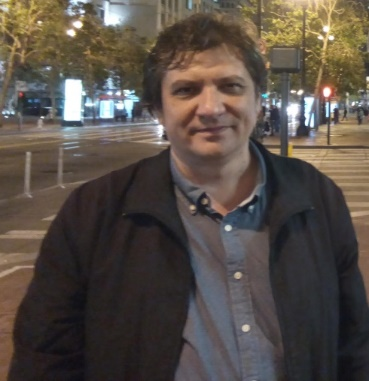
Sergii Khmelevskyi is a Senior Researcher at the Vienna Scientific Cluster Research Center, Vienna University of Technology, Austria. His research focuses on the quantum theory of magnetism in metals and correlated oxides, ab initio calculations, exchange interactions, spin fluctuations, magnetic frustration, and antiferromagnetic spintronics. Since 2016 he has held a senior researcher position at TU Wien, following postdoctoral and assistant professor roles, and he habilitated in Computational Materials Science in 2015. His major contributions include the predictive theory of the Invar anomaly, first-principles theories of 4f-electron compounds and anisotropic spin fluctuations, the prediction of MnAu₂ as a high-Néel-temperature antiferromagnetic spintronics material, and explanations of the FeSi dichotomy and hidden order in oxides. He received the 2014 Science Prize of the City of Vienna and teaches graduate-level Magnetism.

 官方公众号
官方公众号
