
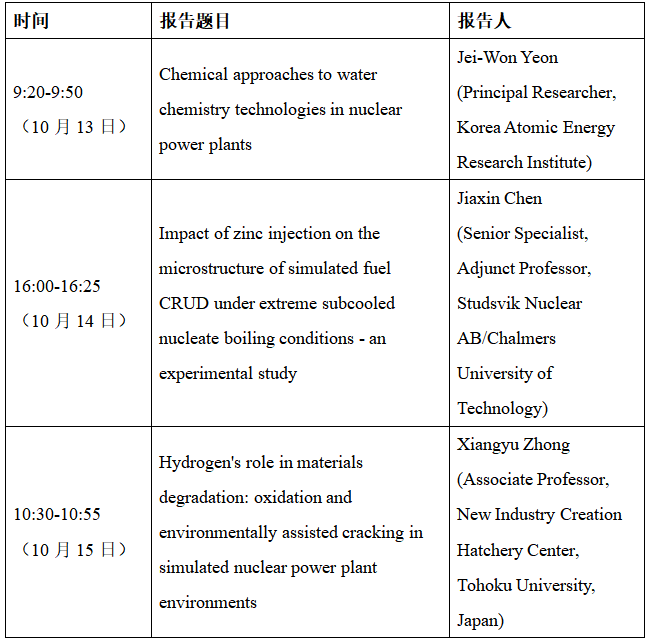
题目1:Chemical approaches to water chemistry technologies in nuclear power plants
题目2:Impact of zinc injection on the microstructure of simulated fuel CRUD under extreme subcooled nucleate boiling conditions - an experimental study
题目3:Hydrogen's role in materials degradation: oxidation and environmentally assisted cracking in simulated nuclear power plant environments
时间:2026年10月13-15日(周二-周四)
地点:沈阳华府酒店四楼金色大厅A&B(沈河区哈尔滨路128号)
日程表:
题目1:Chemical approaches to water chemistry technologies in nuclear power plants
报告摘要:
Water chemistry technologies in nuclear power plants are achieved through a harmonious integration of materials engineering and chemical principles. This study presents a comprehensive synthesis of research focused fundamentally on core chemical principles and mechanisms, reviewing key achievements in advancing nuclear water chemistry through thermodynamic modeling, radiation chemistry, and data-driven diagnostics. First, high-temperature thermodynamic calculations for the water dissociation constant, Kw(T), and H3BO3/LiOH buffer pH were performed using the linear ionic heat capacity approximation. The calculated pKw(T) aligned with existing data up to 250°C, but its accuracy decreased at higher temperatures due to the declining dielectric constant of water, indicating the need for further refinement. Similarly, buffer pH calculations showed reasonable agreement with established guidelines, though incorporating dielectric reduction effects remains essential for precise modeling. To complement these thermodynamic calculations, experimental evaluations using Yttria-Stabilized Zirconia (YSZ) high-temperature pH electrodes were conducted. Second, the impacts of radiolysis were investigated under various aqueous conditions. Organic contaminants (e.g., MIBK, MEK) and air ingress induced system acidification via the formation of organic and nitric acids, respectively. Furthermore, alpha-radiolysis in low-temperature borated water demonstrated a risk of H2 and O2 accumulation due to suppressed recombination kinetics, explaining the chemical operational necessity for Pressurized Water Reactors (PWRs) to establish elevated temperatures prior to power operation, in contrast to Boiling Water Reactors (BWRs) operating with unborated water. Third, fuel crud analytical reliability was enhanced by correlating chemical compositions with radionuclide activity. Analyzing data relationships such as 58Co/Ni and 58Co/60Co provided an internal validation framework to cross-check chemical and radiochemical measurements. Finally, iodine volatility suppression mechanisms were elucidated via radiation-induced redox reactions. Radiolysis-generated H2O2 completely suppressed iodine volatility at pH>7 advancing shutdown chemistry understanding and offering operational advantages for treating iodine-containing radioactive wastewater at lower pH.
报告人简介:
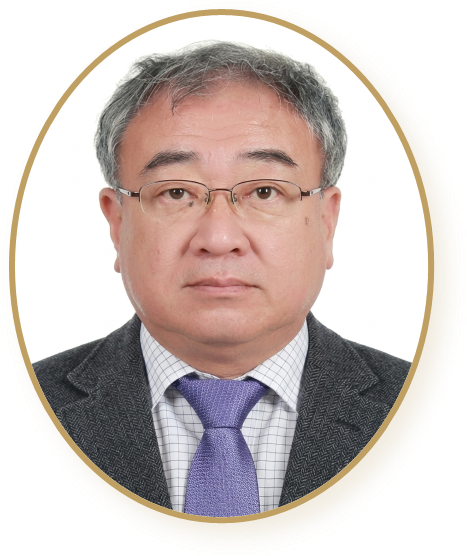
Dr. Jei-Won Yeon is a Principal Researcher in the Nuclear Chemistry Technology Division at the Korea Atomic Energy Research Institute. He obtained his B.S. in Chemistry from Pusan National University and Ph.D. in Materials Science and Engineering from KAIST in 2007. A leading expert in electrochemistry and irradiation water chemistry, he has led over 30 major research projects sponsored by the Korean government and the IAEA. He has published more than 80 peer-reviewed journal articles and has served as a Visiting Professor at Seoul National University since 2023, focusing on advanced modeling and reinterpretation of radiolysis experimental data.
题目2:Impact of zinc injection on the microstructure of simulated fuel CRUD under extreme subcooled nucleate boiling conditions - an experimental study
报告摘要:
Zinc injection is an attractive option for pressurized water reactors because of its potential to reduce plant radiation fields. However, uncertainties remain regarding zinc precipitation on fuel surfaces under subcooled nucleate boiling, reaction with existing fuel CRUD, possible acceleration of CRUD build-up, and associated risks of enhanced cladding corrosion and CIPS/AOA. This paper examines a bounding laboratory case in which a pre-deposited simulated zinc-rich fuel CRUD layer, prepared using ZnFe2O4 as precursor, was exposed for two weeks in an autoclave loop under substantial subcooled nucleate boiling in simulated PWR primary coolant containing 31 wppb zinc. At the end of the test, instant draining was performed to preserve boron-containing species retained within the CRUD layer. Cross-section SEM showed an exposed CRUD thickness of up to approximately 19 µm and an interconnected open-pore structure, with an estimated apparent density of about 0.5 g/cm³. ICP analyses showed low retained inventories of boron and lithium, corresponding to 0.72 wt% B and 0.02 wt% Li in the collected CRUD. SEM/TEM-EDS indicated that zinc was incorporated mainly into mixed spinel-type oxide, interpreted as (Zn,Ni,Fe)3O4, with granular oxide grains containing ~13 wt% Zn. Neither ZnO nor ZnFe2O4 was detected in the scraped CRUD sample in TEM examination. The resulting deposit remained relatively porous and showed limited boron retention compared with dense NiO–spinel CRUD, suggesting that zinc-rich CRUD does not necessarily enhance CIPS/AOA risk under the present test conditions.
报告人简介:

Dr. Jiaxin Chen is Senior Specialist in Corrosion and Materials Testing at Studsvik Nuclear AB, Adjunct Professor at Chalmers University of Technology, Guest Research Professor at Shanghai Jiao Tong University, and an A.N.T. International network expert. With over 27 years of nuclear experience, he studies LWR fuel deposits, water chemistry, SCC of Ni‑alloys and stainless steels, radioactive deposition, oxide films and component failure analysis. He earned his Ph.D. in Inorganic Chemistry (University of Gothenburg, 1995) and has led nuclear R&D, consulting and technical projects at Studsvik since 1997.
题目3:Hydrogen's role in materials degradation: oxidation and environmentally assisted cracking in simulated nuclear power plant environments
报告摘要:Hydrogen plays a critical yet complex role in the degradation of structural materials in nuclear power plant environments, influencing both oxidation behavior and stress corrosion cracking (SCC) susceptibility. Hydrogen can accelerate oxidation kinetics, promoting early-stage SCC initiation, while hydrogen ingress into the metal lattice destabilizes passive films and degrades SCC resistance. In steam generators, hydrogen diffusion from the primary to secondary side further alters corrosion potential and modifies surface oxide structures, complicating degradation assessment across plant systems. To better characterize these effects, we developed an in-situ gaseous hydrogen charging method for SCC tensile testing under high-temperature water conditions. Unlike conventional electrochemical pre-charging techniques, this approach avoids interference with corrosion potential and maintains a stable, controllable concentration of diffusible hydrogen throughout testing, overcoming a key limitation of traditional methods. To enhance test sensitivity, we employed hollow cylindrical tensile specimens with a machining-hardened inner surface, which substantially improved detection of intergranular SCC (IGSCC) using the slow strain rate technique (SSRT). This method offers a faster, more sensitive alternative to constant load tests for evaluating SCC susceptibility in non-sensitized stainless steels. Our results further demonstrate that dissolved hydrogen in high-temperature water enhances both SCC and corrosion fatigue crack initiation, indicating that hydrogen effects are concentration-dependent rather than uniformly beneficial or detrimental. These findings underscore the need to optimize dissolved hydrogen content in reactor coolant chemistry to balance corrosion mitigation against increased cracking susceptibility, providing practical guidance for water chemistry control strategies in nuclear power systems. Separately, creep tests on nickel-based alloys, pressure vessel steel, and cold-worked 316L stainless steel revealed widespread low temperature creep, strongly influenced by hydrogen. These creep rates are large enough to relax residual stresses in plant components - beneficial for weld residual stresses, but potentially detrimental where compressive stresses were intentionally introduced for SCC mitigation.
报告人简介:
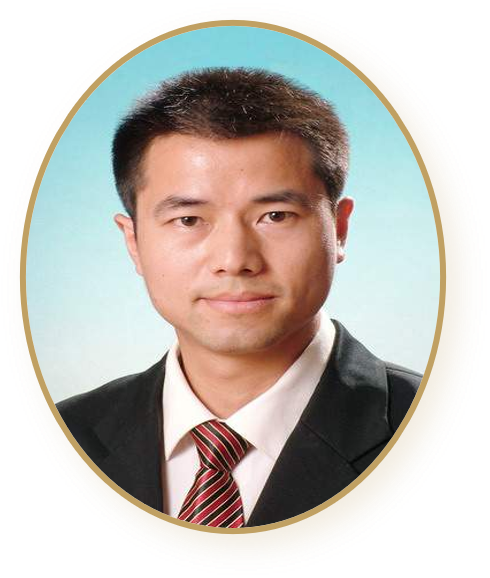
Dr. Xiangyu Zhong received his Ph.D. from the Institute of Metal Research, CAS in 2013. He joined Prof. Shoji’s group at Tohoku University as a postdoc, and became assistant professor in 2018 and associate professor in 2023. His research addresses corrosion, oxidation and environmentally assisted cracking of structural materials under extreme energy‑system environments. He has led and participated in government/industrial projects, published over 40 SCI papers and holds a Japanese patent. He received the Nuclear Engineering and Technology Outstanding Reviewer Award (2021) and serves as guest editor and early‑career board member for several journals.

 官方公众号
官方公众号
