
Lee Hsun Lecture Series (240-R49)
Topic: 2D Ferroelectric Materials for Neuromorphic Memristors
Speaker: Prof. Xixiang ZHANG
Division of Physical Science and Engineering, King Abdullah University of Science & Technology (KAUST), Saudi Arabia
Time: 14:00-15:30, (Wed.) Sep. 23rd, 2026
Venue: Room 403, Shichangxu Building, IMR CAS
Abstract:
Two-dimensional ferroelectrics combine switchable polarization with atomic thickness and clean van der Waals interfaces. These properties make them useful for studying resistive switching and for developing compact memory and neuromorphic devices. This talk will focus on layered ferroelectric systems. In CuCrP₂S₆, electric fields drive transitions between antiferroelectric, ferrielectric, and ferroelectric configurations. The resulting changes in polarization and interface barriers produce a large resistance window, stable retention, and gradual conductance updates. Temperature changes the balance between competing polar states and can reverse the direction of the resistive hysteresis. The same voltage pulses can therefore produce potentiation or depression at different temperatures. We also integrate the CuCrP₂S₆ memristor with a MoS₂ transistor in an all van der Waals 1T1M structure, which reduces leakage and suppresses sneak currents in small arrays. The second part introduces CuInP₂(S₁₋ₓSeₓ)₆. Controlling the Se content creates structural disorder and nanoscale polar regions characteristic of relaxor ferroelectricity. Their gradual response to an electric field enables analog resistance modulation at relatively low voltages. Together, these studies examine how polar phases, interfaces, and local disorder determine the electrical behavior of two-dimensional memristors.
Biograph:
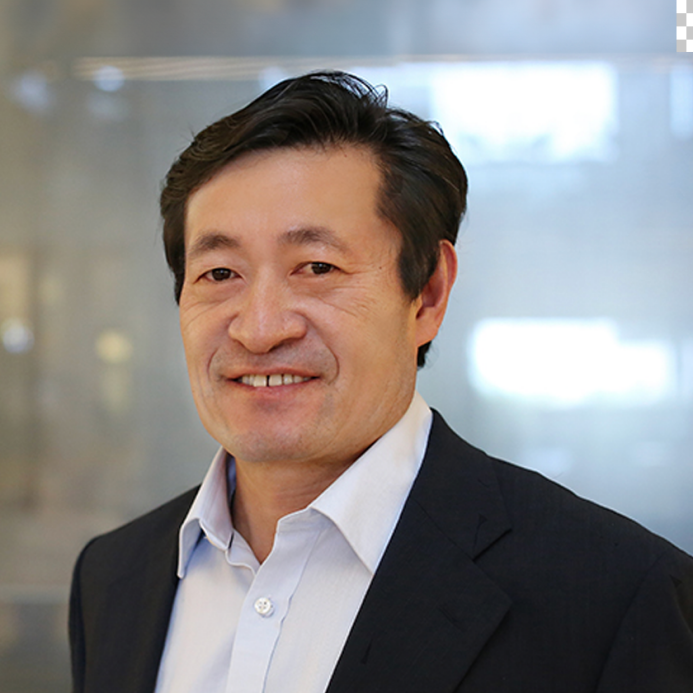
Prof. Xi-Xiang Zhang obtained his PhD degree from the Universitat de Barcelona, Spain, in 1992. After working as a research scientist in Dept. de Fisica Fonamental, Universitat de Barcelona for five years (1992-1997), he joined Hong Kong University of Science and Technology as an assistant professor, and then became a full professor in July 2008. In September 2008, he joined King Abdullah University of Science & Technology (KAUST) as manager of two core labs. He was promoted to director of all core labs in 2012. He became a full professor at KAUST in January 2014. His research interests include magnetism, spintronics, nanomaterials, multiferroic materials, two-dimensional (2D) materials and graphene. Based on Google Scholar, he has co-authored more than 790 papers that received >59000 citations with H-index >110. He is a fellow of the American Physical Society.

 官方公众号
官方公众号
